What Is the Foreign Manufacturers Certification Scheme? A Complete Guide to BIS FMCS
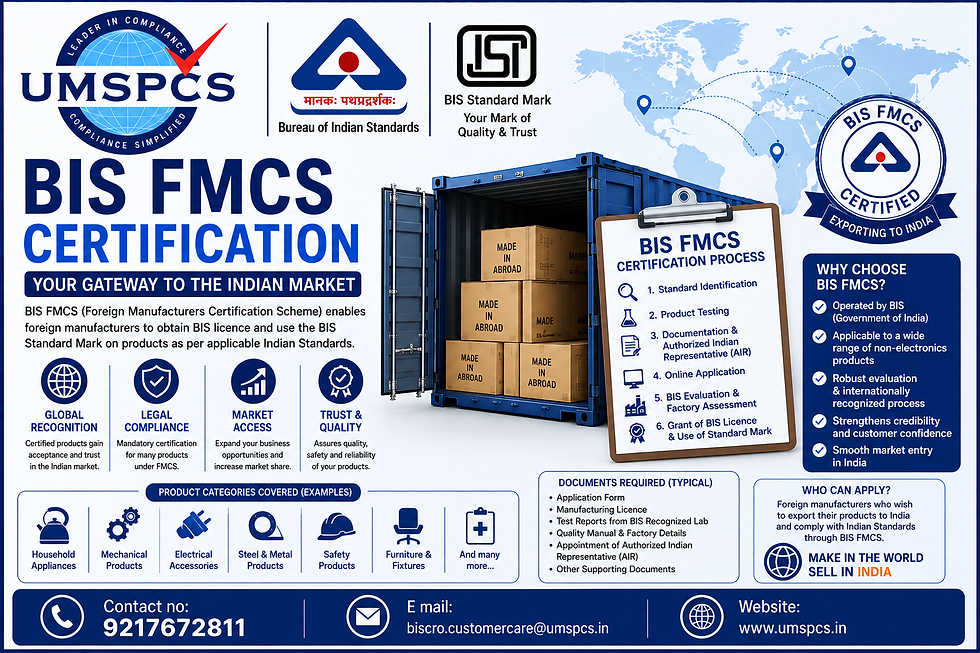
Selling products in India from an overseas manufacturing facility can involve several regulatory requirements. For products that need BIS certification, a foreign manufacturer cannot simply rely on an international test report and begin using the BIS Standard Mark. The manufacturer has to follow the certification route prescribed by the Bureau of Indian Standards (BIS).
One of the main routes created for this purpose is the Foreign Manufacturers Certification Scheme (FMCS).
FMCS allows eligible manufacturers located outside India to obtain a BIS licence for products that conform to the relevant Indian Standards. The scheme has been operated by BIS since 2000 and is administered by the Foreign Manufacturers Certification Department (FMCD) at BIS Headquarters in New Delhi.
For an overseas business planning to enter the Indian market, understanding how FMCS works can help avoid problems with testing, documentation, factory assessment, and the appointment of an Indian representative.
What Is the Foreign Manufacturers Certification Scheme?
The Foreign Manufacturers Certification Scheme, commonly called FMCS, is a BIS certification scheme for manufacturers whose factories are located outside India.
Under the scheme, BIS can grant a licence to a foreign manufacturer to use the BIS Standard Mark on products that comply with the applicable Indian Standard. The licence is connected to the specific manufacturing premises and products covered by the certification.
FMCS is generally used for products other than Electronics and IT products notified under the MeitY Compulsory Registration Scheme (CRS). BIS specifically directs manufacturers of covered Electronics and IT goods toward the CRS route instead.
This distinction is important because a foreign company cannot simply choose FMCS for every product it wants to sell in India.
Who Can Apply for FMCS?
Foreign manufacturers with manufacturing facilities located outside India can apply under FMCS.
BIS requires the manufacturer to have:
Manufacturing machinery and facilities at the factory
Suitable testing arrangements for the applicable Indian Standard
Competent personnel to carry out required testing
Conformity with the relevant Indian Standard
Acceptance of the applicable Scheme of Testing and Inspection (SIT)
Acceptance of the terms and conditions of the BIS licence
A separate application is required for each product/Indian Standard and each manufacturing location, according to BIS's FMCS guidance.
This means a manufacturer with several factories should not assume that one licence automatically covers every production location.
Is FMCS Certification Mandatory?
BIS certification is generally voluntary unless the Central Government makes certification mandatory for a particular product through a Quality Control Order or another applicable requirement.
Where a product is covered by compulsory BIS certification, the manufacturer may need a valid BIS licence before importing or selling that product in India.
Therefore, an overseas manufacturer should first check two things:
Whether its product is covered by a relevant Indian Standard.
Whether BIS certification is mandatory for that product.
The answer can change depending on the product, applicable Quality Control Order, and current regulatory requirements.
What Is an Authorised Indian Representative?
One of the important features of FMCS is the Authorised Indian Representative (AIR).
A foreign manufacturer needs to nominate an AIR located in India to handle specified responsibilities connected with the BIS licence. BIS states that the AIR should be an Indian resident and legally appointed by the foreign manufacturer.
The AIR can play an important role in communication with BIS, regulatory compliance, sample-related activities, and other responsibilities connected with the operation of the licence.
The foreign manufacturer should therefore select its representative carefully. The AIR is not merely a name added to the application; the position carries ongoing responsibilities.
Also Read - MTCTE Certification Documents Required
How Does the FMCS Certification Process Work?
The FMCS process involves several stages.
1. Identify the Applicable Indian Standard
The manufacturer first needs to determine the correct Indian Standard for its product.
This is the foundation of the application because testing, manufacturing controls, documentation, and the scope of the BIS licence are linked to the applicable standard.
2. Review Factory Requirements
The overseas factory must have the necessary manufacturing infrastructure, quality controls, testing equipment, and competent personnel.
BIS provides product-specific manuals and Scheme of Inspection and Testing requirements for different standards.
3. Appoint an AIR
The manufacturer nominates an Authorised Indian Representative who meets the BIS requirements.
The AIR's details form part of the certification arrangement and are endorsed in the BIS licence.
4. Prepare and Submit the Application
The manufacturer prepares the prescribed application and supporting documents.
There has been an important recent change in the application process. BIS states that FMCS applications can now be submitted online through the Manakonline portal, and from 1 June 2026, only online applications are accepted for the standard FMCS process; offline applications were accepted only up to 31 May 2026.
Applicants should therefore avoid relying on older information that still describes hard-copy submission as the normal route.
5. Application Scrutiny
BIS examines the application and may raise queries. The manufacturer needs to respond to those queries and provide any missing information.
BIS specifically notes that incomplete applications, delayed responses, and unpaid dues can affect the licensing timeline.
6. Factory Visit and Assessment
Once the application is complete, BIS arranges a visit to the foreign manufacturing premises.
During the visit, BIS verifies the manufacturing and testing infrastructure and draws samples for independent testing.
This is a key difference from simply submitting paperwork. The actual factory must be capable of producing the product according to the applicable Indian Standard.
7. Testing and Licence Grant
Samples drawn during the assessment are tested according to the applicable requirements. If the product and manufacturing arrangements meet the necessary conditions, BIS can proceed toward granting the licence.
The manufacturer can then use the BIS Standard Mark only according to the conditions and scope of the licence.
Documents Commonly Required
The exact checklist depends on the product and applicable Indian Standard, but an FMCS application can involve documents such as:
Completed application information
Company registration details
Factory information
Details of manufacturing machinery
Testing equipment information
Laboratory and testing personnel details
Product specifications
Quality-control information
Process flow chart
Plant layout
Scheme of Inspection and Testing information
AIR nomination documents
Relevant test reports and technical records
Undertakings and declarations required by BIS
The manufacturer should prepare documents according to the current BIS checklist and product-specific requirements rather than using a generic old checklist.
FMCS vs BIS Certification for Indian Manufacturers
The basic objective is similar: demonstrate conformity with an applicable Indian Standard and obtain permission to use the BIS Standard Mark.
The main difference is where the manufacturing facility is located.
An Indian manufacturer applies through the relevant BIS certification process, while a manufacturer with its factory outside India uses the FMCS route when applicable.
Foreign manufacturers also have additional requirements, particularly the nomination of an AIR and assessment of the overseas manufacturing facility.
Common Mistakes Foreign Manufacturers Should Avoid
A few errors can make the process unnecessarily difficult.
Choosing the wrong standard: The entire application depends on the correct Indian Standard.
Ignoring factory readiness: BIS assesses actual manufacturing and testing arrangements.
Selecting an unsuitable AIR: The representative has continuing responsibilities under the scheme.
Using outdated application procedures: FMCS moved to online application submission from 1 June 2026.
Relying only on foreign test reports: BIS states that reports against standards other than the relevant Indian Standard are not accepted as a substitute for the required Indian Standard testing.
Applying for multiple factories under one application: BIS requires separate applications for each manufacturing premise and product/Indian Standard.
Businesses that need support with documentation and certification coordination may work with a specialist such as umspcs, while confirming the latest requirements directly with BIS.
Conclusion
The Foreign Manufacturers Certification Scheme provides a structured way for overseas manufacturers to obtain BIS certification for eligible products intended for the Indian market. The scheme focuses on conformity with Indian Standards and includes assessment of the actual overseas manufacturing facility.
The process involves identifying the correct standard, preparing the factory, appointing an Authorised Indian Representative, submitting the application, responding to BIS queries, undergoing factory assessment, and completing product testing.
For foreign businesses, preparation is especially important because the certification involves coordination between the manufacturer, AIR, laboratories, and BIS. Checking the latest BIS requirements before beginning the application can prevent avoidable delays and help ensure that the product is ready for the Indian market.
Frequently Asked Questions
1. What does FMCS stand for?
FMCS stands for Foreign Manufacturers Certification Scheme. It is a BIS scheme through which eligible foreign manufacturers can obtain a BIS licence for products conforming to relevant Indian Standards.
2. Who can apply under FMCS?
Manufacturers whose factory is located outside India can apply under FMCS, provided they meet the applicable manufacturing, testing, quality, and certification requirements.
3. Is an Authorised Indian Representative mandatory?
Yes. BIS requires foreign manufacturers to nominate an Authorised Indian Representative who is located in India and meets the prescribed conditions.
4. Does FMCS apply to electronic products?
FMCS generally covers products other than Electronics and IT goods notified under the MeitY CRS. Covered Electronics and IT products follow the applicable CRS route.
5. Is a factory inspection required under FMCS?
Yes. BIS conducts a visit to the foreign manufacturing location to verify manufacturing and testing infrastructure and to draw samples for independent testing.
6. Can one FMCS application cover several factories?
Generally, no. BIS states that a separate application is required for each product/Indian Standard and each manufacturing location.
7. Can FMCS applications be submitted online?
Yes. BIS now accepts FMCS applications through the Manakonline portal. BIS states that offline applications were accepted only up to 31 May 2026, with online submission becoming mandatory from 1 June 2026.


Comments