BIS CRS Certification for Laptops: A Complete Guide for Manufacturers and Importers
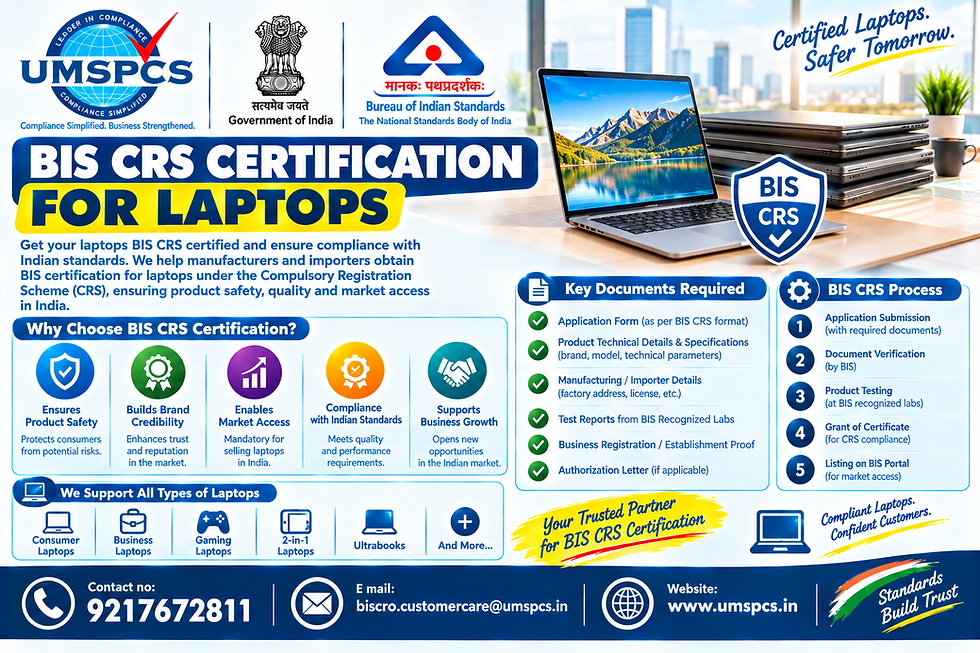
Laptops have become a part of everyday life. Students use them for learning, professionals depend on them for work, and businesses use them for everything from accounting to customer management. With so many laptop models entering the Indian market, product safety has become an important concern.
This is where BIS CRS Certification for laptops comes into the picture.
The Bureau of Indian Standards (BIS) operates the Compulsory Registration Scheme (CRS) for several electronic and IT products. Laptops, notebooks and tablets are among the products covered under this scheme. Manufacturers and businesses dealing with these products need to understand the applicable requirements before placing their products on the Indian market.
What Is BIS CRS Certification?
BIS CRS is a registration-based conformity assessment system for specified electronic and IT products. Unlike the traditional BIS licence route associated with the ISI Mark, CRS is designed around registration and conformity with the applicable Indian Standard.
For laptops and related products, BIS currently lists IS/IEC 62368 Part 1:2023 – Audio/Video, Information and Communication Technology Equipment – Part 1: Safety Requirements as the applicable standard in its Scheme-II product list.
The purpose is straightforward: products covered by the scheme must meet the relevant safety requirements before they are registered for the Indian market.
Is BIS CRS Mandatory for Laptops?
Yes, laptops/notebooks/tablets fall under the products covered by the BIS Compulsory Registration Scheme.
The BIS product list identifies “Laptop/Notebook/Tablets” under Scheme-II. The category has been part of the compulsory registration framework since its original implementation in 2013.
However, manufacturers should not rely only on older product lists when preparing an application. BIS has updated the standards and regulatory framework over time. The current BIS website should be checked to confirm the applicable standard and requirements for the particular product being registered.
Who Needs BIS CRS Registration?
The requirement primarily concerns manufacturers of products covered under CRS. Depending on the business model, importers and other parties involved in bringing electronic products into India may also need to ensure that the relevant manufacturer and product registration requirements have been fulfilled.
For example, an overseas company manufacturing laptops for sale in India cannot simply ship an unregistered product and assume that the responsibility ends with the importer. The manufacturer and the product models need to be properly covered under the applicable BIS framework.
This makes it important to determine certification requirements before production, shipment or commercial launch.
How Does the BIS CRS Process Work for Laptops?
The process generally begins with identifying the correct product category and applicable Indian Standard.
The manufacturer then has the product tested through a laboratory recognised by BIS for the relevant testing requirements. BIS maintains test report formats for CRS products, including laptops/notebooks/tablets.
Once testing is completed, the manufacturer can proceed with the registration application and submit the required information and supporting documents through the BIS CRS system.
The process involves more than simply submitting a laptop sample. Details about the manufacturer, factory, product model and test report need to correspond correctly. Any mismatch between the tested product and the model details submitted in the application can create unnecessary complications.
What Documents Are Generally Required?
The exact documentation can depend on the product and application, but manufacturers should be prepared with accurate technical and business information.
Typical requirements may include:
Manufacturer details and factory information
Product and model information
Test report from a BIS-recognised laboratory
Technical specifications
Details of the applicable Indian Standard
Brand and marking information
Authorisation-related documents, where applicable
Supporting documents required by the BIS application system
It is wise to prepare these details before beginning the application. Small inconsistencies in model numbers, brand names or manufacturer information can result in delays.
Also Read: BIS ISI License for Indian Manufacturers
Why Is Testing Important?
Testing is at the heart of the CRS process.
A laptop contains several interconnected components, including a power system, battery, display, motherboard and charging circuitry. Safety testing helps determine whether the product meets the requirements of the applicable standard.
The current BIS listing places laptops under IS/IEC 62368 Part 1:2023. This standard addresses safety requirements for audio/video and information and communication technology equipment.
Manufacturers should therefore make sure that the exact configuration being submitted for testing represents the product that will actually be sold in India.
What About Multiple Laptop Models?
Laptop manufacturers often have several models that look almost identical but differ in processors, displays, batteries, memory or other specifications.
This is one area where careful documentation matters.
Manufacturers should determine whether different models can be covered together under the applicable BIS provisions or whether separate registration or inclusion is required. The BIS CRS system includes provisions for registration and model inclusion, so businesses should review the current procedure rather than assuming that one registration automatically covers every product variant.
Keeping a clear model-wise record can make future additions much easier.
Common Mistakes Manufacturers Should Avoid
One of the most common problems is beginning the application without first checking the current standard.
Another issue is submitting a test report for a model that does not exactly match the product details in the registration application.
Manufacturers should also avoid treating BIS registration as a one-time paperwork task. Product models can change, standards can be revised and regulatory requirements can be updated. The BIS website currently records amendments to the applicable electronics and IT goods framework, including an amendment dated March 10, 2026.
For businesses managing several compliance requirements, maintaining an organised product and document record can make the process considerably easier. A structured compliance reference such as umspcs can also be useful when keeping track of certification-related information.
Benefits of BIS CRS Registration for Laptop Businesses
For manufacturers and brands, proper BIS registration provides a clear compliance route for covered products.
It can also make the product launch process more organised because testing, technical documentation and model information have to be reviewed before registration.
For consumers, the regulatory framework is intended to help ensure that covered electronic products meet the applicable safety requirements before they enter the market. The government describes CRS as a system intended to protect consumers from substandard electronic and IT products.
Conclusion
BIS CRS Certification for laptops is an important compliance requirement for businesses manufacturing or bringing covered laptop products to the Indian market. Since laptops, notebooks and tablets fall under the CRS framework, manufacturers need to identify the correct standard, arrange the required testing and submit accurate registration information.
The process becomes much easier when it is planned before the product reaches the market. Manufacturers should pay particular attention to model numbers, technical specifications, test reports and the latest BIS requirements.
Most importantly, businesses should check the latest information published by BIS rather than relying on an old checklist. Standards and regulatory requirements can change, and staying updated is an essential part of maintaining compliance.
Frequently Asked Questions
1. Is BIS CRS certification required for laptops in India?
Yes. Laptop, notebook and tablet products are included under the BIS Compulsory Registration Scheme.
2. Which standard applies to laptops under CRS?
The current BIS Scheme-II listing identifies IS/IEC 62368 Part 1:2023 for laptops, notebooks and tablets.
3. Is BIS CRS the same as an ISI licence?
No. CRS is a registration scheme under Scheme-II, while the ISI Mark is associated with BIS certification under other conformity assessment schemes. The two should not be treated as interchangeable.
4. Is product testing required for laptop registration?
Yes. Testing against the applicable requirements is an important part of the CRS registration process, and BIS provides recognised testing arrangements and test report formats for covered products.
5. Can several laptop models be included under one registration?
The answer depends on the applicable BIS provisions and the relationship between the models. Manufacturers should review the current model-inclusion requirements rather than assuming that every variant is automatically covered.
6. Can the BIS requirements change?
Yes. BIS and the concerned government authorities can update standards, notifications and implementation requirements. Manufacturers should check the latest BIS information before applying or renewing their compliance arrangements.


Comments