BIS Certification vs QCO Compliance: Understanding the Difference in India
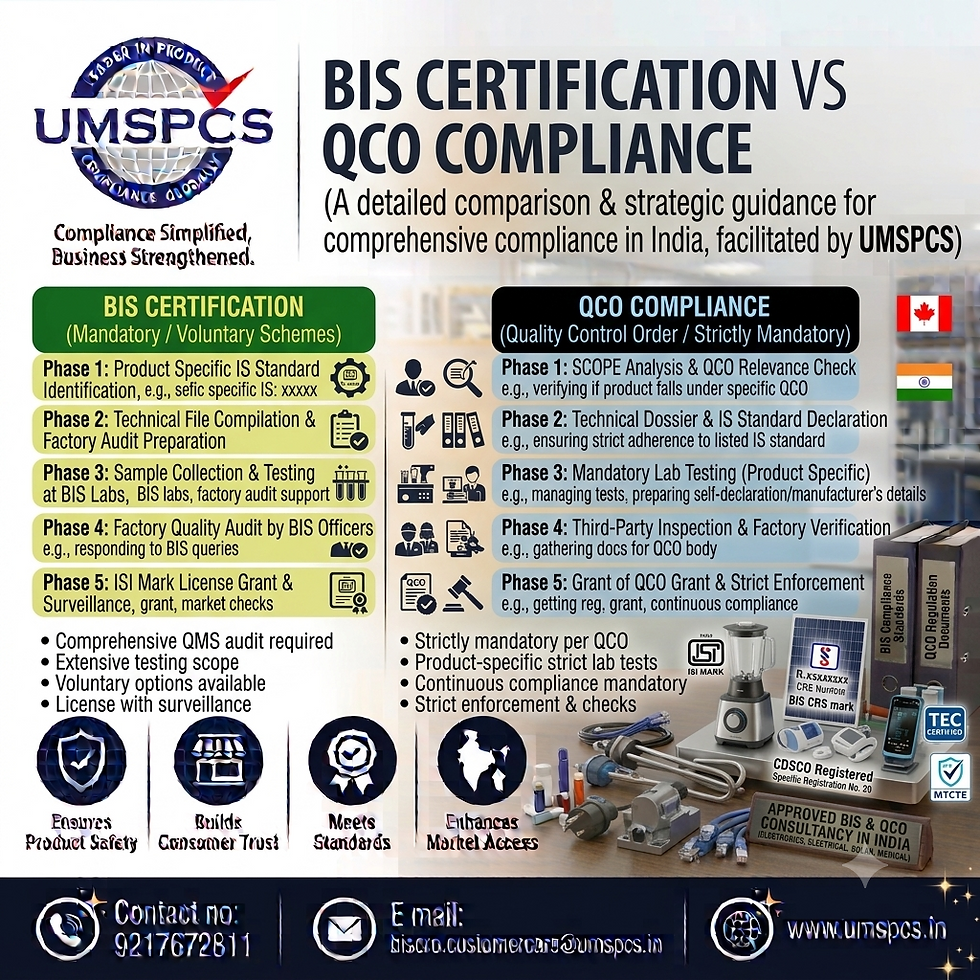
When businesses start selling products in India, two terms often appear together: BIS Certification and QCO Compliance. Because both are connected with Indian Standards and product quality, it is easy to assume that they mean the same thing.
They do not.
BIS certification is the conformity-assessment mechanism through which BIS evaluates products and manufacturers under its applicable schemes. A Quality Control Order (QCO), on the other hand, is a government regulatory order that makes compliance with specified Indian Standards compulsory for the products covered by that order.
The relationship between the two is important for manufacturers, importers and sellers because a QCO can turn what would otherwise be voluntary compliance into a mandatory legal requirement. BIS confirms that its certification scheme is generally voluntary, but the Central Government makes compliance compulsory for specified products through QCOs.
What Is BIS Certification?
The Bureau of Indian Standards (BIS) is India's national standards body and operates different conformity-assessment schemes for products.
Under a BIS product certification scheme, a manufacturer demonstrates that its product and relevant manufacturing arrangements meet the requirements of the applicable Indian Standard. Depending on the scheme, BIS may assess manufacturing facilities, quality-control arrangements and testing capabilities, while product conformity can be established through laboratory testing, factory testing or a combination of methods.
For products covered under Scheme-I, for example, a manufacturer can obtain a licence to use the BIS Standard Mark after meeting the applicable requirements.
But BIS certification is not automatically mandatory for every product that has an Indian Standard.
That distinction is where QCOs become important.
What Is QCO Compliance?
QCO stands for Quality Control Order.
A QCO is issued by the Central Government, generally through the relevant ministry or department, to make conformity to specified Indian Standards compulsory for particular products.
BIS explains that QCOs can be introduced for reasons including public interest, human, animal or plant health, environmental safety, prevention of unfair trade practices and national security.
Once the relevant QCO comes into force, businesses dealing with products covered by that order must follow the requirements stated in it.
For many QCO-covered products, this means obtaining the applicable BIS certification and using the required Standard Mark. BIS states that after the commencement of a QCO, covered products generally cannot be manufactured, imported, distributed, sold, hired, leased, stored or exhibited for sale without the required Standard Mark under a valid BIS licence or Certificate of Conformity, subject to the terms and exemptions of the particular order.
BIS Certification vs QCO Compliance: The Basic Difference
The simplest way to understand the difference is this:
BIS Certification is the conformity-assessment route.
QCO Compliance is the legal requirement imposed by the government for products covered by a particular Quality Control Order.
In other words, a QCO can require a business to obtain BIS certification.
This is why saying that a product "has an Indian Standard" is not enough to determine whether BIS certification is mandatory. The manufacturer must check whether the product has been brought under compulsory certification through a QCO or another applicable regulatory notification.
Is BIS Certification Mandatory for Every Product?
No.
BIS clearly states that its certification scheme is basically voluntary in nature. However, products brought under compulsory certification by the Central Government must meet the relevant requirements.
This creates two broad situations.
Voluntary Certification
A manufacturer may choose BIS certification for a product even when the government has not made certification compulsory for that product.
The reasons can include demonstrating conformity, meeting customer requirements or supporting market acceptance.
Mandatory Certification
If the product is covered by a QCO or another compulsory certification requirement, the manufacturer cannot treat BIS certification as simply optional.
The applicable QCO and its effective date need to be followed.
How Does a QCO Affect Manufacturers and Importers?
A QCO can change the compliance obligations associated with a product.
For example, a manufacturer may have been producing a product according to an Indian Standard voluntarily. If a QCO is subsequently issued and comes into force, the business may need to obtain the required BIS certification and comply with the specified requirements before continuing regulated sales.
Importers also need to pay attention. BIS's QCO guidance states that domestic requirements generally apply to imported goods as well, unless a specific exemption is provided.
Therefore, importing a product does not automatically avoid Indian product-compliance requirements.
What Should Businesses Check Before Applying?
Before starting a BIS application, businesses should avoid looking only at the Indian Standard number.
A better approach is to check:
The exact product description
The applicable Indian Standard
Whether the product is covered by a QCO
The QCO's commencement or enforcement date
The applicable BIS conformity-assessment scheme
Any amendments, exemptions or exclusions
Manufacturing and testing requirements
Marking and labelling conditions
BIS provides a current list of products under compulsory certification and also maintains information about QCOs and upcoming orders. Its current QCO information includes orders with future enforcement dates, showing why businesses should monitor regulatory updates rather than rely on an old compliance checklist.
What Happens After a QCO Comes Into Force?
Once a QCO becomes effective, the manufacturer needs to ensure that the product complies with the requirements specified by the order.
Depending on the applicable scheme, this can involve:
Identifying the correct Indian Standard
Preparing the manufacturing facility
Establishing appropriate quality-control procedures
Arranging testing
Submitting a BIS application
Undergoing assessment
Obtaining the applicable licence or Certificate of Conformity
Using the Standard Mark according to the applicable conditions
BIS states that manufacturers seeking a product certification licence need appropriate manufacturing infrastructure, process controls, quality control and testing capabilities.
Common Mistakes in QCO Compliance
One common mistake is assuming that every Indian Standard automatically creates a legal certification obligation.
Another is checking an old QCO without reviewing subsequent amendments or changes to the implementation date.
Businesses may also confuse different BIS schemes. BIS operates multiple conformity-assessment routes, including Scheme-I, Scheme-II and Scheme-IV for different categories of products.
For companies dealing with several regulated products, professional assistance from a compliance provider such as umspcs can help with identifying applicable standards, reviewing regulatory requirements and preparing documentation.
However, businesses should always verify the current requirements against the relevant government order and BIS information.
Why the Difference Matters
Understanding the difference between certification and compliance helps businesses plan correctly.
A manufacturer might see an Indian Standard and assume that certification is compulsory. Another might see that BIS certification is generally voluntary and conclude that no action is needed.
Both assumptions can be wrong.
The correct question is: Has the government made compliance with this particular standard mandatory for this particular product, and if so, what conformity-assessment route does the applicable order require?
That approach provides a much clearer compliance path.
Conclusion
BIS Certification and QCO Compliance are closely connected, but they are not the same thing.
BIS certification is the conformity-assessment mechanism used to establish that a product meets applicable requirements. A QCO is a government regulatory instrument that makes specified standards compulsory for the products covered by the order.
For manufacturers and importers, the practical lesson is simple: do not rely only on the existence of an Indian Standard. Check the latest BIS compulsory-certification list, the relevant QCO, its enforcement date, applicable scheme and any amendments or exemptions.
A careful review before manufacturing or importing can prevent avoidable compliance problems and help businesses understand exactly what is required for their product.
Frequently Asked Questions
1. Is BIS certification and QCO compliance the same?
No. BIS certification is a conformity-assessment mechanism, while a QCO is a government order that can make compliance with specified Indian Standards mandatory.
2. Does every product with an Indian Standard require BIS certification?
No. BIS certification is generally voluntary unless the government has made certification or conformity with the applicable standard compulsory through a QCO or another legal requirement.
3. Can a QCO make BIS certification mandatory?
Yes. For products covered by applicable QCOs, the government can require the Standard Mark under a BIS licence or Certificate of Conformity, according to the relevant conformity-assessment scheme.
4. Do QCO requirements apply to imported products?
Generally, yes. BIS's QCO guidance states that domestic requirements applicable to domestically produced goods generally apply to imports as well, unless a specific exemption is provided.
5. Where can I check whether my product is under a QCO?
BIS maintains a list of products under compulsory certification along with information about applicable QCOs and amendments. Businesses should also check the latest government notifications and enforcement dates.
6. Can BIS certification remain voluntary even when an Indian Standard exists?
Yes. The existence of an Indian Standard by itself does not necessarily make certification compulsory. Mandatory compliance depends on the applicable regulatory notification, such as a QCO.
7. What should a manufacturer check first?
The manufacturer should identify the exact product, applicable Indian Standard, relevant QCO, enforcement date, certification scheme and any exemptions or amendments before beginning the certification process.


Comments