BIS Certification for Cement in India: Process, Standards, Documents and Requirements
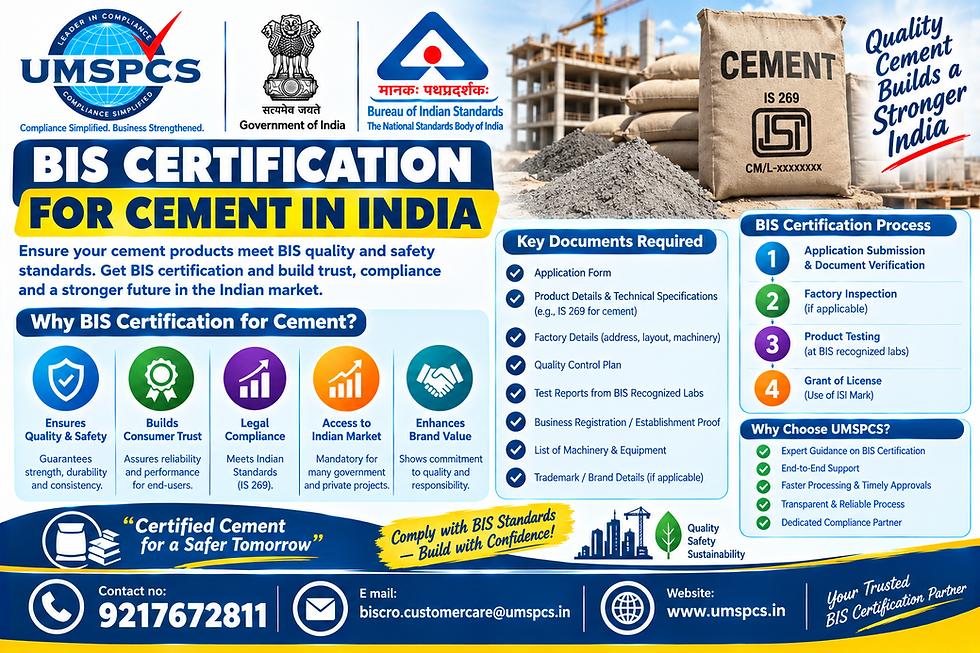
Cement is one of the most important materials used in construction. From residential buildings and bridges to roads and industrial structures, the quality of cement can directly affect the strength and durability of the finished work. Because of this, cement manufacturers in India have to meet specific quality requirements before placing their products in the market.
BIS Certification for Cement plays an important role in this system. Cement varieties covered under the applicable compulsory certification requirements must comply with the relevant Indian Standard and obtain the required BIS licence for using the Standard Mark. BIS currently lists numerous cement varieties under its compulsory certification scheme, including Ordinary Portland Cement, Portland Pozzolana Cement, Portland Slag Cement, Rapid Hardening Portland Cement and others.
For manufacturers, understanding the applicable standard and certification process is the first step toward obtaining approval without unnecessary delays.
What Is BIS Certification for Cement?
BIS certification confirms that a cement product conforms to the applicable Indian Standard. The certification is operated under the Scheme-I (ISI Mark Scheme) of the Bureau of Indian Standards.
The applicable requirements depend on the type of cement being manufactured. For example, Ordinary Portland Cement is covered under IS 269:2015, while Portland Slag Cement is covered under IS 455:2015. Portland Pozzolana Cement is covered under IS 1489, with separate parts for fly-ash-based and calcined-clay-based cement.
This means a manufacturer cannot simply apply for a general "cement certificate." The certification needs to be connected with the correct product and corresponding Indian Standard.
Which Cement Products Require BIS Certification?
BIS maintains a list of cement products under compulsory certification. The current Scheme-I listing includes a wide range of varieties, such as:
Ordinary Portland Cement — IS 269
Portland Pozzolana Cement, fly-ash based — IS 1489 Part 1
Portland Pozzolana Cement, calcined-clay based — IS 1489 Part 2
Portland Slag Cement — IS 455
Masonry Cement — IS 3466
Rapid Hardening Portland Cement — IS 8041
White Portland Cement — IS 8042
Hydrophobic Portland Cement — IS 8043
Sulphate Resisting Portland Cement — IS 12330
Low Heat Portland Cement — IS 12600
Composite Cement — IS 16415
BIS's current compulsory-certification listing also includes other specialised cement varieties. Manufacturers should check the latest BIS notification and product-specific requirements before beginning an application.
How Does the BIS Certification Process Work?
The certification process begins with identifying the correct Indian Standard for the product.
Once the applicable standard is confirmed, the manufacturer needs to review the relevant BIS product manual. These manuals provide important information about sampling, testing, required equipment and the Scheme of Inspection and Testing.
For example, the BIS product manual for Portland Pozzolana Cement specifies the raw materials to be considered, sample requirements, testing equipment and inspection and testing arrangements.
A typical process involves the following stages:
1. Identify the Applicable Standard
The first step is determining which Indian Standard applies to the cement being manufactured. This is essential because testing and production requirements vary between cement varieties.
2. Prepare the Manufacturing Facility
The manufacturing unit should have suitable production facilities and the required quality-control arrangements. The manufacturer should also have the testing equipment and infrastructure specified under the applicable product requirements.
3. Submit the BIS Application
The manufacturer submits the application and relevant documents through the BIS certification system. Product details, manufacturing information, testing arrangements and other required particulars need to be provided accurately.
4. Factory Assessment
BIS may assess the manufacturing premises to verify whether the production and quality-control arrangements meet the applicable requirements.
5. Product Testing
Samples are tested according to the relevant Indian Standard and product manual. Cement testing can cover physical and chemical characteristics.
For example, BIS laboratory information for cement includes tests relating to fineness, setting time, expansion, compressive strength and various chemical parameters.
6. Grant of Licence
If the manufacturing facilities, testing results and other requirements are found satisfactory, BIS can grant the licence permitting the manufacturer to use the Standard Mark according to the licence conditions.
Also Read - BIS ISI Certification Cost in India
What Documents Are Generally Required?
The exact document list can vary according to the product and application, but manufacturers should generally be prepared with information relating to:
Company or factory registration
Manufacturing address and contact details
Details of manufacturing machinery
Manufacturing process information
Raw material details
Quality-control arrangements
Testing equipment details
Calibration records where applicable
Test reports
Factory layout
Details of technical and quality-control personnel
Applicable product information
Relevant declarations and undertakings
It is important to match the documentation with the specific BIS product manual rather than relying on a generic checklist.
Why Testing Is Important for Cement Certification
Cement quality cannot be judged simply by appearance. Its performance depends on characteristics such as strength development, fineness, setting behaviour, soundness and chemical composition.
This is why the testing stage is a major part of BIS certification. The exact tests depend on the relevant Indian Standard.
For instance, BIS's information for IS 269:2015 identifies Ordinary Portland Cement as a separately covered product, while BIS laboratory listings provide test facilities and charges for different cement-related tests.
Manufacturers should therefore ensure that their internal testing facilities and production controls are ready before applying.
Common Problems Manufacturers Face
Certification delays can occur when the wrong standard is selected, required testing equipment is unavailable, documents contain inconsistencies or product samples fail to meet the prescribed requirements.
Another common issue is treating all cement products as though they have identical requirements. They do not. For example, the raw materials and testing arrangements specified for Portland Slag Cement differ from those applicable to other cement varieties.
Careful preparation at the beginning can prevent many of these problems.
Role of Professional Compliance Support
BIS certification involves technical standards, documentation, testing and factory-level requirements. Manufacturers who are unfamiliar with the process may find it useful to take guidance from an experienced compliance professional.
A service provider such as umspcs can help businesses organise documentation, understand applicable requirements and prepare for the certification process. However, the manufacturer's actual production and quality systems must still meet the applicable BIS requirements.
Conclusion
BIS Certification for Cement is an important part of maintaining quality and regulatory compliance in India's construction-material sector. Since different cement varieties are covered by different Indian Standards, manufacturers need to begin by identifying the correct standard for their product.
From factory preparation and documentation to testing and assessment, every stage has a role in obtaining the BIS licence. Reviewing the relevant BIS product manual before applying can help manufacturers understand the testing, equipment and inspection requirements more clearly.
Most importantly, certification should not be treated as paperwork alone. Consistent production, reliable testing and proper quality control are what help a manufacturer maintain conformity after the licence is granted.
Frequently Asked Questions
1. Is BIS certification mandatory for cement in India?
Yes, cement varieties covered under the applicable compulsory certification requirements must comply with the relevant BIS requirements before being manufactured or sold as regulated products in India.
2. What is the BIS standard for Ordinary Portland Cement?
Ordinary Portland Cement is covered under IS 269:2015.
3. What standard applies to Portland Slag Cement?
Portland Slag Cement is covered under IS 455:2015.
4. Does every type of cement have the same BIS requirements?
No. Testing, raw materials, equipment and other requirements can differ depending on the applicable Indian Standard and product manual.
5. Is factory testing equipment required for BIS cement certification?
The applicable product requirements specify testing arrangements and equipment. Manufacturers should review the relevant BIS product manual to determine what is required for their particular cement variety.
6. Can a manufacturer apply for BIS certification without checking the Indian Standard?
It is not advisable. Identifying the correct Indian Standard should be one of the first steps because the certification requirements are product-specific.


Comments